FlowMatch: Building a One-Stop Marketplace for the Things Enthusiasts Actually Care About
A case study in turning a collector mindset into a marketplace experience for rare cars, watches, mechanical objects, and the unusual pieces that deserve a better home.
 OPEN IMAGE ↗
Most marketplaces are built around utility. FlowMatch is built around obsession. The idea is simple: give enthusiasts one place to discover, buy, sell, and eventually match with people who care about the same unusual objects they do.
Not everything people collect fits neatly into a category.
The interesting part of the enthusiast economy is what sits between categories: a rare automobile, a vintage chronograph, a camera with a cult following, a mechanical oddity, or a collectible object that only makes sense once someone explains why it matters.
FlowMatch is designed around that behavior. Rather than treating every listing as a commodity, the concept frames the marketplace as a place where provenance, taste, rarity, and the story behind an object are part of the product itself.
A marketplace can feel curated without becoming exclusive.
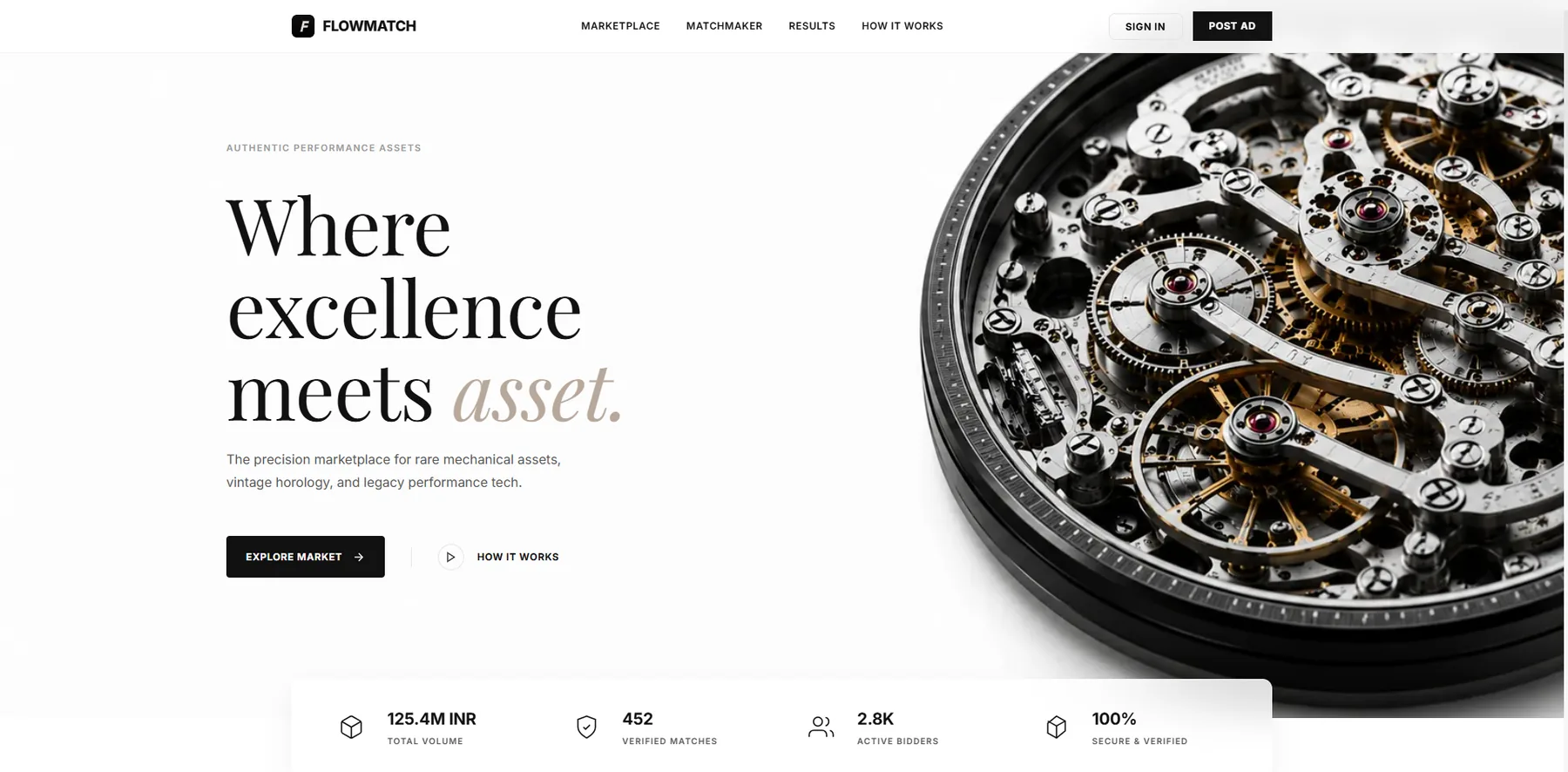
The challenge was to make the experience feel premium without turning it into a gallery that nobody knows how to use. The visual language therefore balances editorial presentation with familiar marketplace cues: clear calls to action, confident navigation, obvious pathways, and enough information to make a serious buyer keep exploring.
That balance is important. Enthusiasts do not want friction for the sake of friction. They want confidence that the object, the seller, and the transaction are worth their time.
The product is not just the listing. It is the feeling that you finally found the right place for the thing you have been looking for.FlowMatch product direction
The interface should make rare things feel easy to understand.
The visual system uses editorial typography, generous whitespace, high-quality imagery, and strong contrast so that the objects remain the story. The interface stays intentionally restrained: fewer distractions, clearer hierarchy, and enough breathing room for the details to carry the experience.
That same thinking extends to the product structure. Marketplace, Matchmaker, Results, and How It Works become clear destinations rather than a maze of utility screens.
- Give enthusiasts a broader home for rare and collectible goods instead of forcing everything into separate vertical marketplaces.
- Make discovery feel editorial while keeping buying and selling flows understandable.
- Create space for matching and community signals alongside traditional marketplace actions.
- Make trust part of the interface rather than an afterthought buried in fine print.
Build around the way people care, not only the way they transact.
FlowMatch works as a portfolio case study because it is really a product-positioning problem disguised as a marketplace problem. The strongest version of the idea is not “another place to post an item.” It is a trusted environment for people whose purchases are driven by curiosity, identity, scarcity, and craft.
That makes the website more than a front door. It becomes the first demonstration of the product philosophy: precise, confident, visually considered, and built for people who notice the details.